



Fiji is a signatory to TRIPS Agreement, Berne Convention for the Protection of Literary and Artistic works since 1970 and Convention establishing WIPO in 1972. Fiji is required under international law to accord and abide by the principle of ‘national treatment’ under TRIPS and other conventions.
Oceanica IP is established to provide intellectual property services to both local and international owners of intellectual property. Whether it be your mark, brand, song, signs, music or any other piece of original work, we are here to protect.
To learn more about the practice areas that we at Oceanica IP serve, click on “EXPAND” next to each title below.
Fiji Trade Mark
A trademark is a sign capable of distinguishing the goods or services of one enterprise from those of other enterprises. Trademarks are protected by intellectual property rights.
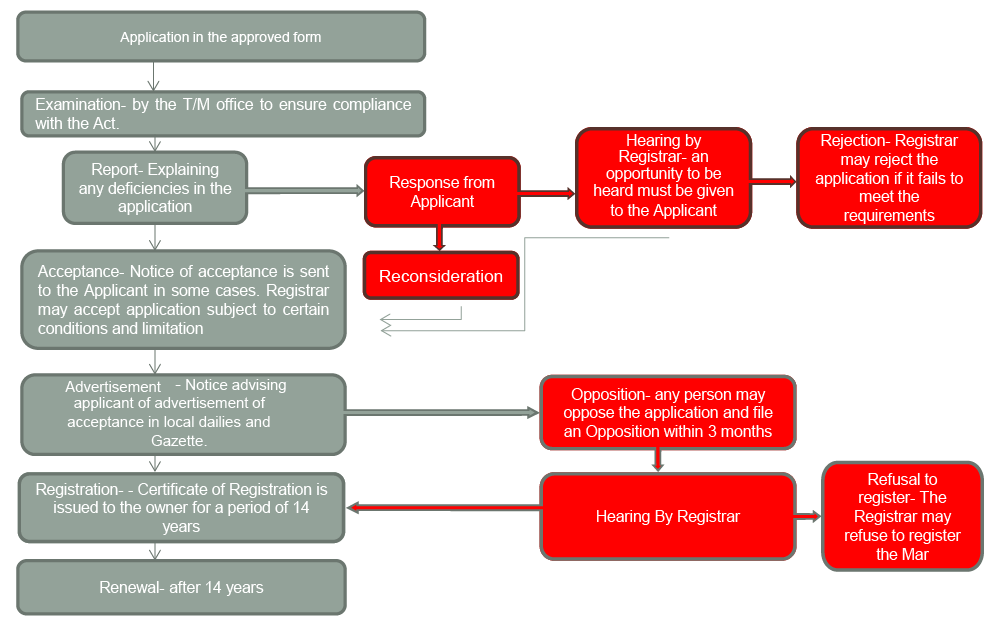
Fiji is guided by the Trademark Act Cap 242. Fiji still uses the old British classification system rather than the Nice Classification system. You can file either an independent trade mark application or an application based on prior United Kingdom registration
UK-based applications tend to be processed more quickly and do not need to be advertised for opposition purposes. Independent trade mark registrations need to be renewed every 14 years and UK-based registrations need to be renewed when the UK registration is renewed.
Trade Mark Registration System
Requirements for Filing an Application for Registration
Oceanica Intellectual Property will require the followings from you to file an application for registration:-
- An original authorisation of agent (Click here to view);
- An information sheet (Click here to view)
- All details including the name, address and calling of the applicant;
- The specification of goods;
- Twenty (20) prints of the mark if the mark is not a word mark;
- A certified copy of the United Kingdom trade mark certificate ( for UK based application).
Note:- The Fiji Trade Marks Office will require an original authorisation of agent and information sheet.
Patents
A patent is an exclusive right granted for an invention, which is a product or a process that provides an original way of doing something, or proposes a new practical answer to a problem. To get a patent, procedural information about the invention must be disclosed to the public in a patent application.
In Fiji, patent application is guided by the Patent Act Cap 239.
Licenses
By obtaining Intellectual Property (IP) rights and then using them purposefully, rights owners can guard and increase their income-generating prospect. Holders of IP rights, such as patents, trademarks and copyright, can license these rights to others in return for a fee. Licenses grant rights without transferring ownership of the Intellectual Property.
Copyright
In Fiji, copyright is protected under the Copyright Act 1999. The law protects the property rights of creators/owners over their original music, songs, paintings, designs, signs, photographs, drawings, books, sculpture, films, articles, dances and all other literary and artistic works.
The implication behind the law is to assure the people who create the works that their works are not unlawfully reproduced, distributed, performed, displayed, or sold without their consent and in a way that would deprive them of income and discourage further creative works.
Copyright Infringement is a very serious offence in Fiji. A person commits an offence if he/she does any of the followings without a licence or consent of the owner:-
- makes for sale or hire,
- imports for commercial use;
- possesses in the course of business with a view to commit an offence; and
- offers for sale or hire, exhibits in public or distributes in the course of business any protected works under the Copyright Act 1999.
A person also commits an offence if he/she:-
- makes or in possession of an object specifically designed to make infringing copies of the protected work in the course of business;
- causes a literary, dramatic or musical work to be performed or a sound recording or film to played and shown in public; when he/she knows or ought reasonably to know that copyright in the work would be infringed.
Trade Secrets
Generally, any confidential business information which provides a company a competitive edge may be considered a trade secret. Trade secrets involve manufacturing, industrial and commercial secrets. The unsanctioned use of such information by persons other than the holder is regarded as an unfair practice and a violation of the trade secret. Depending on the legal system, the protection of trade secrets forms part of the general concept of protection against unfair competition or is based on specific provisions or case law on the protection of confidential information.
The subject matter of trade secrets is usually defined in general terms and comprises of sales techniques, distribution procedures, consumer profiles, advertising tactics, lists of suppliers and clients, and manufacturing processes. While a final determination of what information constitutes a trade secret will depend on the circumstances of each individual case, clearly unfair practices in respect of secret information include industrial or commercial espionage, breach of contract and breach of confidence.
Litigation
Litigation is the term used to describe proceedings initiated between two opposing parties to enforce or defend a legal right. Litigation is typically settled by agreement between the parties, but may also be heard and decided by a jury or judge in court.
Contrary to popular belief, litigation is not simply another name for a lawsuit. Litigation includes any number of activities before, during, and after a lawsuit to enforce a legal right. In addition to the actual lawsuit, pre-suit negotiations, arbitrations, facilitations and appeals may also be part of the litigation process.
Agreement Drafting & Negotiation
Intellectual Property Agreements are used to outline the rights and responsibilities of parties involved in the development, pursuit or usage of certain knowledge. Such agreements can include Non-disclosure/Confidentiality Agreements, Joint Development Agreements, Assignments, License Agreements, Technology Transfer Agreements and Joint Venture/Collaboration Agreements. Carefully preparing the terms of such agreements at the front end of a commercial relationship can produce substantial gains in the future, should rights ever need to be applied.
Opinions
Legal Opinions are required in the course of business to provide a rational analysis of the risks and potential gains of seeking or exploiting intellectual property rights, or preventing others from exercising them. Such opinions can include evaluating the patentability of a researcher’s discovery or the freedom-to-operate in a given technology area. Where particular patent rights are concerned, it may be necessary to determine whether a research/manufacturing venture is possible via a non-infringement opinion, or whether the patent can be enforced through a validity opinion. Alternately, a design-around opinion can be obtained to lay out the safe path around the patent’s claims.
Commercial Law
Commercial law, also known as business law, is the body of law that applies to the rights, relations, and conduct of persons and businesses engaged in commerce, merchandising, trade, and sales. It is often considered to be a branch of civil law and deals with issues of both private law and public law.
Commercial law includes within its compass such titles as principal and agent; carriage by land and sea; merchant shipping; guarantee; marine, fire, life, and accident insurance; bills of exchange and partnership. It can also be understood to regulate corporate contracts, hiring practices, and the manufacture and sales of consumer goods. Many countries have adopted civil codes that contain comprehensive statements of their commercial law.